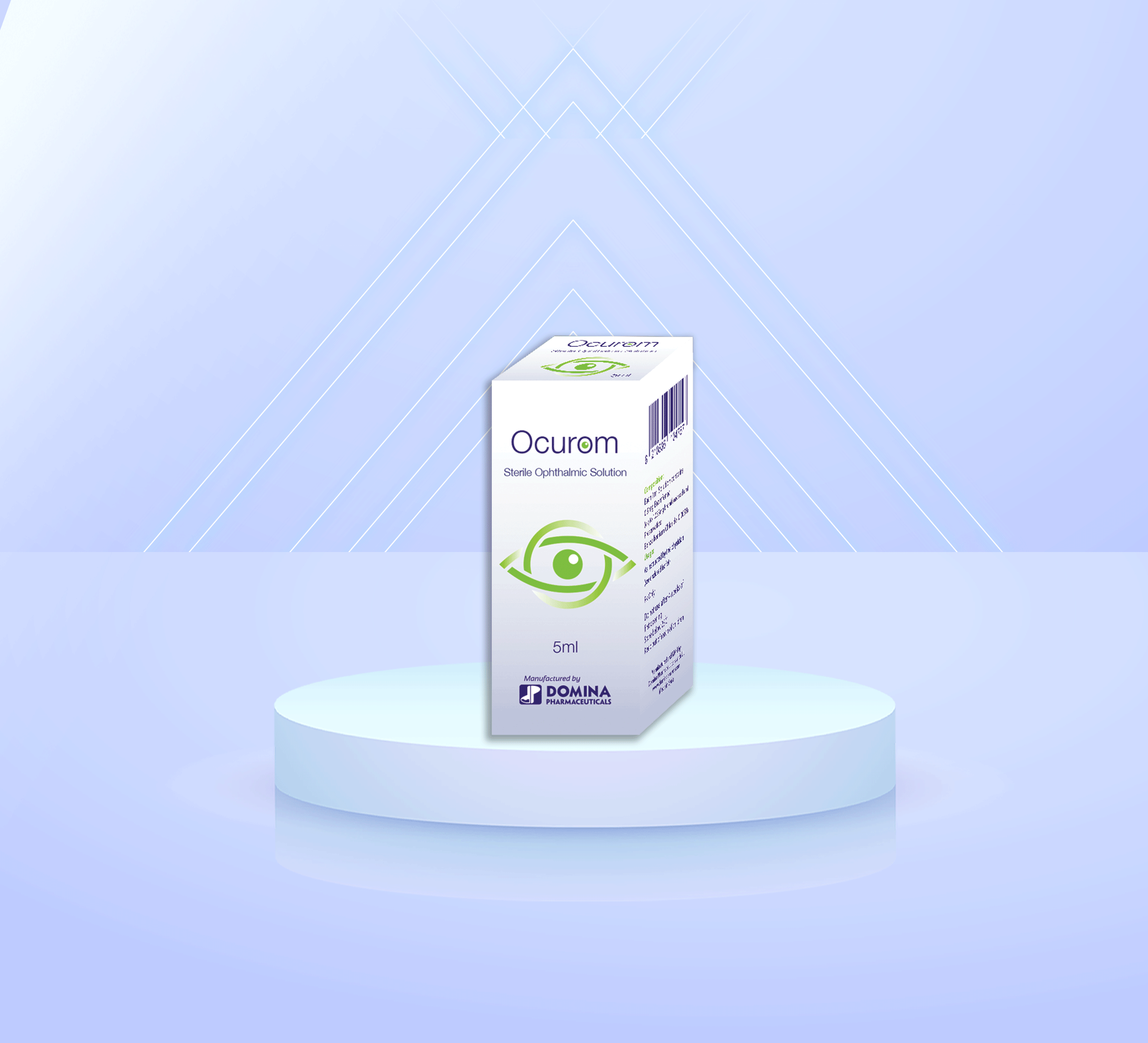
Composition:
Each 1ml solution contains 0.9mg Bromfenac (equivalent to 1.035mg bromfenac sodium)
Excipients:
Boric acid, sodium hydroxide, disodium edetate, polysorbate, sodium borate, povidone, sodium sulfite anhydrous, benzalkonium chloride, purified water.
Mechanism of action:
Ocurom is a non-steroidal anti-inflammatory drug (NSAID) that has anti-inflammatory activity which is thought to be due to its ability to block prostaglandin synthesis by inhibiting primarily cyclooxygenase 2 (COX-2). Cyclooxygenase 1 (COX-1) is only inhibited to a small extent.
Pharmacokinetic Properties:
Absorption:
Ocurom efficiently permeates the cornea of cataract patients: A single dose resulted in a mean peak aqueous humour concentration of 79±68 ng/ml at 150-180 minutes after dosing. Concentrations were maintained for 12 hours in aqueous humour with measurable levels up to 24 hours in major ocular tissues including the retina.
Distribution:
Ocurom shows high binding to plasma proteins. In vitro, the 99.8% were bound to proteins in human plasma. No biological relevant melanin binding was observed in vitro.
Studies in rabbits using radio-labelled bromfenac have demonstrated that highest concentrations after topical
administration is observed in the cornea followed by the conjunctiva and the aqueous humour. Only low concentrations were observed in the lens and vitreous.
Biotransformation:
In vitro studies indicate that bromfenac is mainly metabolized by CYP2C9, which is absent in both iris-ciliary body and retina/choroid and the level of this enzyme in the cornea is less than 1% compared to the corresponding hepatic level.
In orally treated humans unchanged parent compound is the major component in plasma. Several conjugated and unconjugated metabolites have been identified with the cyclic amide being the major urinary metabolite.
Elimination:
After ocular administration the half-life of bromfenac in aqueous humour is 1.4 h indicating rapid elimination.
Indications:
Ocurom is indicated in adults for the treatment of postoperative ocular inflammation following cataract extraction.
Contraindications:
Hypersensitivity to bromfenac or to any of the excipients or to other non-steroidal anti-inflammatory medicinal products (NSAIDs).
Bromfenac is contraindicated in patients in whom attacks of asthma, urticaria or acute rhinitis are precipitated by acetylsalicylic acid or by other medicinal products with prostaglandin synthetase inhibiting activity.
Posology and method of administration:
Ocurom is for ocular use.
Use in adults, including the elderly:
one drop of Ocurom in the affected eye(s) twice daily, beginning the next day after cataract surgery and continuing through the first 2 weeks of the postoperative period.
The treatment should not exceed 2 weeks as safety data beyond this is not available.
If more than one topical ophtalmic medicinal product is being used, each one should be administered at least 5 minutes apart.
To prevent contamination of the dropper-tip and solution, care must be taken not to touch the eyelids, surrounding areas or other surfaces with the dropper-tip of the bottle.
The safety and efficacy of bromfenac have not been established in pediatric patients, and there is no information available regarding this.
Warnings and Precautions:
All topical NSAIDs may slow or delay healing like topical corticosteroids. Concomitant use of NSAIDs and topical steroids may increase the potential for healing problems.
- Cross-sensitivity: There is the potential for cross-sensitivity to acetylsalicylic acid, phenylacetic acid derivatives, and other NSAIDs. Therefore, treating individuals who have previously exhibited sensitivities to these medicinal products has to be avoided.
- Susceptible persons: In susceptible patients, continued use of topical NSAIDs, including bromfenac may result in epithelial breakdown, corneal thinning, corneal erosion, corneal ulceration or corneal perforation. These events may be sight threatening. Patients with evidence of corneal epithelial breakdown should immediately discontinue use of topical NSAIDs and should be closely monitored for corneal health. Consequently, in at risk patients concomitant use of ophthalmic corticosteroids with NSAIDs may lead to a higher risk of corneal adverse events.
- Ocular infection: An acute ocular infection may be masked by the topical use of anti-inflammatory medicinal products.
- Use of contact lenses: In general, contact lens wear is not recommended during the postoperative period following cataract surgery. Therefore, patients should be advised not to wear contact lenses during treatment with Bromfenac.
Undesirable Effects:
|
System organ class |
Frequency |
Adverse reactions |
|
Eye disorders |
Uncommon |
Visual acuity reduced, Hemorrhagic retinopathy, Corneal epithelium defect, Corneal erosion (mild or moderate), Corneal epithelium disorder, Corneal oedema, Retinal exudates, Eye pain, Eyelid bleeding, Vision blurred, Photophobia, Eyelid oedema, Eye discharge, Eye pruritus, Eye irritation, Eye redness, Conjunctival hyperemia, Abnormal sensation in eye, Ocular discomfort. |
|
Respiratory, thoracic and mediastinal disorders |
Uncommon |
Epistaxis, Cough, Nasal sinus drainage |
|
General disorders and administrative site conditions |
Uncommon |
Face swelling |
Patients with evidence of corneal epithelial breakdown should be instructed to immediately discontinue use of Bromfenac and should be monitored closely for corneal health.
Pregnancy:
There are no adequate data from the use of bromfenac in pregnant women. Studies in animals have shown reproductive toxicity. The potential risk for humans is unknown. Since the systemic exposure in non-pregnant women is negligible after treatment with Bromfenac, the risk during pregnancy could be considered low.
However, because of the known effects of prostaglandin biosynthesis-inhibiting medicinal products on the fetal cardiovascular system (closure of ductus arteriosus), the use of Bromfenac during third trimester pregnancy should be avoided. The use of Bromfenac is in general not recommended during pregnancy unless the benefit outweighs the potential risk.
Breast-feeding:
It is unknown whether bromfenac or its metabolites are excreted in human milk. Animal studies have shown excretion of bromfenac in the milk of rats following very high oral doses. No effects on the breastfed newborn/infant are anticipated since the systemic exposure of the breastfeeding woman to bromfenac is negligible. Bromfenac can be used during breast-feeding.
Effects on ability to drive and use machines:
Bromfenac has minor influence on the ability to drive and use machines. Transient blurring of vision may occur on instillation. If blurred vision occurs at instillation patients should be advised to refrain from driving or using machines until vision is clear.
Overdose:
No abnormal findings or adverse reactions of clinical concern were noted upon administration of two drops 2mg/ml solution four times a day for the period of up to 28 days. Accidental administration of more than one drop should not result in increased topical exposure as excessive volume would rinse out of the eye due to limited conjunctival sac capacity. There is practically no risk of adverse effects due to accidental oral ingestion. Ingestion of the 5ml bottle content corresponds to an oral dose of less than 5mg bromfenac, which is 30 times lower than daily dose of bromfenac oral formulation formerly used.
If Bromfenac is accidentally ingested, fluids should be taken to dilute the medicinal product.