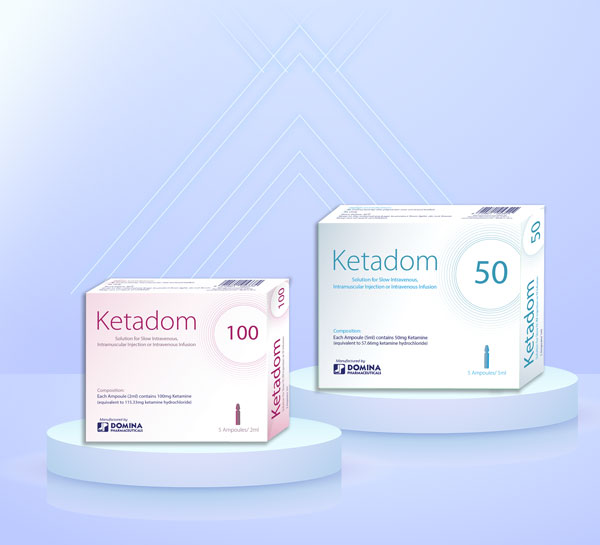
Composition:
Ketadom 50: Each 5ml ampoule contains 50mg ketamine equivalent to 57.66mg ketamine hydrochloride (10mg/1ml).
Ketadom 100: Each 2ml ampoule contains contains 100mg ketamine equivalent to 115.33mg ketamine hydrochloride (50mg/1ml).
Pharmacodynamics:
Ketadom is a rapidly acting general anesthetic for intravenous or intramuscular use with a distinct pharmacological action. Ketamine hydrochloride produces dissociative anesthesia characterised by catalepsy, amnesia, and marked analgesia which may persist into the recovery period. Pharyngeal-laryngeal reflexes remain normal and skeletal muscle tone may be normal or can be enhanced to varying degrees. Mild cardiac and respiratory stimulation and occasionally respiratory depression occur.
Mechanism of Action:
Ketadom induces sedation, immobility, amnesia and marked analgesia. The anesthetic state produced by ketamine has been termed “dissociative anaesthesia” in that it appears to selectively interrupt association pathways of the brain before producing somesthetic sensory blockade. It may selectively depress the thalamoneocortical system before significantly obtunding the more ancient cerebral centres and pathways (reticular-activating and limbic systems). Numerous theories have been proposed to explain the effects of ketamine, including binding to N-methyl-D-aspartate (NMDA) receptors in the CNS, interactions with opiate receptors at central and spinal sites and interaction with norepinephrine, serotonin and muscarinic cholinergic receptors.
Pharmacokinetics:
Absorption: Ketadom is rapidly absorbed following intra-muscular administration.
Distribution: Ketadom is rapidly distributed into perfused tissues including brain and placenta. At an intravenous bolus dose of 2.5 mg/kg, the distribution phase of ketamine lasts about 45 minutes, with a half-life of 10 to 15 minutes, which is associated with the duration of the anaesthetic effect (about 20 minutes). Plasma ketamine concentrations are about 1.8 to 2.0 μg/mL at 5 minutes after an intravenous bolus injection of 2 mg/kg dose, and about 1.7 to 2.2 μg/mL at 15 minutes after an intramuscular injection of 6 mg/kg dose in adults and children.
Metabolism: Metabolism takes place in liver. CYP3A4 enzyme is the primary enzyme responsible for ketamine N-demethylation to norketamine in human liver microsomes; with CYP2B6 and CYP2C9 enzymes as minor contributors.
Excretion: Elimination half-life is approximately 2-3 hours, and the renal excretion, mostly as conjugated metabolites.
Indications:
Ketadom is indicated in children and in adults, as an anesthetic agent for diagnostic and surgical procedures.
- When used by intravenous or intramuscular injection, Ketadom is best suited for short procedures. With additional doses, or by intravenous infusion, Ketadom can be used for longer procedures. If skeletal muscle relaxation is desired, a muscle relaxant should be used and respiration should be supported.
- For the induction of anesthesia prior to the administration of other general anesthetic agents.
- To supplement other anesthetic agents.
- When the intramuscular route of administration is preferred.
- Debridement, painful dressings, and skin grafting in burned patients, as well as other superficial surgical procedures.
- Neurodiagnostic procedures such as pneumoencephalograms, ventriculograms, myelograms, and lumbar punctures.
- Diagnostic and operative procedures of the eye, ear, nose, and mouth, including dental extractions.
- Anesthesia in poor-risk patients with depression of vital functions or where depression of vital functions must be avoided, if at all possible.
- Orthopedic procedures such as closed reductions, manipulations, femoral pinning, amputations, and biopsies. Sigmoidoscopy and minor surgery of the anus and rectum, circumcision and pilonidal sinus.
- Cardiac catheterization procedures.
- Caesarean section; as an induction agent in the absence of elevated blood pressure.
- Anesthesia in the asthmatic patient, either to minimize the risks of an attack of bronchospasm developing, or in the presence of bronchospasm where anesthesia cannot be delayed.
Contraindications:
Hypersensitivity to the active substance or to any of the excipients.
In persons in whom an elevation of blood pressure would constitute a serious hazard.
Ketamine should not be used in patients with eclampsia or pre-eclampsia, severe coronary or myocardial disease, cerebrovascular accident or cerebral trauma.
Dosage and Administration:
For intravenous infusion, intravenous injection or intramuscular injection.
Adults, elderly (over 65 years) and children: for surgery in elderly patients’ ketamine has been shown to be suitable either alone or supplemented with other anesthetic agents.
Preoperative preparations: Ketadom has been safely used alone when the stomach was not empty. However, since the need for supplemental agents and muscle relaxants cannot be predicted, when preparing for elective surgery it is advisable that nothing be given by mouth for at least six hours prior to anesthesia. Premedication with an anticholinergic agent (e.g., atropine, hyoscine or glycopyrrolate) or another drying agent should be given at an appropriate interval prior to induction to reduce ketamine-induced hypersalivation. Midazolam, diazepam, lorazepam, or flunitrazepam used as a premedicate or as an adjunct to ketamine, have been effective in reducing the incidence of emergence reactions.
Onset and duration: As with other general anesthetic agents, the individual response to Ketadom is somewhat varied depending on the dose, route of administration, age of patient, and concomitant use of other agents, so that dosage recommendation cannot be absolutely fixed. The dose should be titrated against the patient's requirements. Because of rapid induction following intravenous injection, the patient should be in a supported position during administration. An intravenous dose of 2mg/kg of body weight usually produces surgical anesthesia within 30 seconds after injection and the anesthetic effect usually lasts 5 to 10 minutes. An intramuscular dose of 10 mg/kg of bodyweight usually produces surgical anesthesia within 3 to 4 minutes following injection and the anesthetic effect usually lasts 12 to 25 minutes. Return to consciousness is gradual.
Ketamine as the sole anesthetic agent: Intravenous Infusion: The use of Ketadom by continuous infusion enables the dose to be titrated more closely, thereby reducing the amount of drug administered compared with intermittent administration. This results in a shorter recovery time and better stability of vital signs. A solution containing 1mg/ml of ketamine in dextrose 5% or sodium chloride 0.9% is suitable for administration by infusion.
General Anesthesia Induction: An infusion corresponding to 0.5 – 2mg/kg as total induction dose.
Maintenance of anesthesia: Anesthesia may be maintained using a microdrip infusion of 10 - 45 mcg/kg/min (approximately 1 – 3mg/min). The rate of infusion will depend on the patient's reaction and response to anesthesia. The dosage required may be reduced when a long-acting neuromuscular blocking agent is used.
Intermittent Injection: Intravenous Route Induction: The initial dose Ketadom administered intravenously may range from 1 mg/kg to 4.5mg/kg (in terms of ketamine base). The average amount required to produce 5 to 10 minutes of surgical anesthesia has been 2.0mg/kg. It is recommended that intravenous administration be accomplished slowly (over a period of 60 seconds). More rapid administration may result in respiratory depression and enhanced pressor response.
Dosage in Obstetrics: for vaginal delivery or in caesarean section, intravenous doses ranging from 0.2 to 1.0mg/kg are recommended.
Intramuscular Route: The initial dose of Ketadom administered intramuscularly may range from 6.5mg/kg to 13mg/kg (in terms of ketamine base). A low initial intramuscular dose of 4 mg/kg has been used in diagnostic maneuvers and procedures not involving intensely painful stimuli. A dose of 10 mg/kg will usually produce 12 to 25 minutes of surgical anaesthesia.
Dosage in Hepatic Insufficiency: Dose reductions should be considered in patients with cirrhosis or other types of liver impairment.
Maintenance of general anaesthesia: Lightening of anaesthesia may be indicated by nystagmus, movements in response to stimulation, and vocalization. Anaesthesia is maintained by the administration of additional doses of ketamine by either the intravenous or intramuscular route. Each additional dose is from ½ to the full induction dose recommended above for the route selected for maintenance, regardless of the route used for induction. The larger the total amount of Ketadom administered, the longer will be the time to complete recovery.
Ketadom as induction agent prior to the use of other general anesthetics: If Ketadom has been administered intravenously and the principal anesthetic is slow-acting, a second dose of Ketadom may be required 5 to 8 minutes following the initial dose. If Ketadom has been administered intramuscularly and the principal anesthetic is rapid-acting administration of the principal anesthetic may be delayed up to 15 minutes following the injection of Ketadom.
Ketadom as supplement to anesthetic agents: Ketadom is clinically compatible with the commonly used general and local anesthetic agents when an adequate respiratory exchange is maintained. The dose Ketadom for use in conjunction with other anesthetic agents is usually in the same range as the dosage stated above; however, the use of another anesthetic agent may allow a reduction in the dose of Ketadom.
Warnings:
- To be used only in hospitals by or under the supervision of experienced medically qualified anesthetists except under emergency conditions, as with any general anesthetic agent, resuscitative equipment should be available and ready for use.
- The intravenous dose should be administered over a period of 60 seconds. More rapid administration may result in transient respiratory depression or apnea and enhanced pressor response.
- Because pharyngeal and laryngeal reflexes usually remain active, mechanical stimulation of the pharynx should be avoided unless muscle relaxants, with proper attention to respiration, are used.
- In surgical procedures involving visceral pain pathways, Ketamine should be supplemented with an agent which obtunds visceral pain.
Precautions:
Ketamine should be used with caution in patients with the following conditions:
- Chronic alcoholic and the acutely alcohol-intoxicated patient.
- Ketamine is metabolized in the liver and hepatic clearance is required for termination of clinical effects. A prolonged duration of action may occur in patients with cirrhosis or other types of liver impairment. Dose reductions should be considered in these patients. Abnormal liver function tests associated with ketamine use have been reported, particularly with extended use (>3 days) or drug abuse.
- Since an increase in cerebrospinal fluid (CSF) pressure has been reported during ketamine anesthesia, ketamine should be used with special caution in patients with preanesthetic elevated cerebrospinal fluid pressure.
- Patients with globe injuries and increased intraocular pressure (e.g., glaucoma) because the pressure may increase significantly after a single dose of ketamine.
- Patients with neurotic traits or psychiatric illness (e.g., schizophrenia and acute psychosis).
- Patients with acute intermittent porphyria.
- Use in caution in patients with seizures.
- Patients with hyperthyroidism or patients receiving thyroid replacement (increased risk of hypertension and tachycardia).
- Patients with pulmonary or upper respiratory infection (ketamine sensitizes the gag reflex, potentially causing laryngospasm).
- Patients with intracranial mass lesions, a presence of head injury, or hydrocephalus.
- Emergence Reaction: The psychological manifestations vary in severity between pleasant dream-like states, vivid imagery, hallucinations, nightmares and emergence delirium (often consisting of dissociative or floating sensations). In some cases, these states have been accompanied by confusion, excitement, and irrational behavior which a few patients recall as an unpleasant experience. Emergence delirium phenomena may occur during the recovery period. The incidence of these reactions may be reduced if verbal and tactile stimulation of the patient is minimized during the recovery period. This does not preclude the monitoring of vital signs.
- Cardiovascular: Because of the substantial increase in myocardial oxygen consumption, ketamine should be used in caution in patients with hypovolemia, dehydration or cardiac disease, especially coronary artery disease (e.g., congestive heart failure, myocardial ischemia and myocardial infarction). In addition, ketamine should be used with caution in patients with mild-to-moderate hypertension and tachyarrhythmias. Cardiac function should be continually monitored during the procedure in patients found to have hypertension or cardiac decompensation.
Elevation of blood pressure begins shortly after the injection of Ketamin, reaches a maximum within a few minutes and usually returns to preanesthetic values within 15 minutes after injection.
The median peak rise of blood pressure in clinical studies has ranged from 20 to 25 percent of preanesthetic values. Depending on the condition of the patient, this elevation of blood pressure may be considered a beneficial effect, or in others, an adverse reaction.
- Long-Term Use: Cases of cystitis, including hemorrhagic cystitis, acute kidney injury, hydronephrosis, and ureteral disorders have been reported in patients being given ketamine on a long term basis, especially in the setting of ketamine abuse. These adverse reactions develop in patients receiving long term ketamine treatment after a time ranging from 1 month to several years. Ketamine is not indicated nor recommended for long term use. Hepatotoxicity has also been reported in patients with extended use (> 3 days).
- Drug Abuse and Dependence: Ketamine has been reported as being a drug of abuse. If used on a daily basis for a few weeks, dependence and tolerance may develop, particularly in individuals with a history of drug abuse and dependence. Therefore, the use of ketamine should be closely supervised and it should be prescribed and administered with caution.
Side Effects:
Common side effects: Hallucination, abnormal dreams, nightmare, confusion, agitation, abnormal behavior.
nystagmus, hypertonia, tonic clonic movements, diplopia, blood pressure increased; heart rate increased, respiratory rate increased, nausea, vomiting, erythema, rash morbilliform.
Uncommon Side effects: Anorexia, anxiety, bradycardia, arrhythmia, hypotension, respiratory depression, laryngospasm, injection site pain, injection site rash.
Rare side effects: Anaphylactic reaction, delirium flashback, dysphoria, insomnia, disorientation, obstructive airway disorder, apnea, cystitis, hemorrhagic cystitis.
Not known side effects: Intraocular pressure increased, Liver function test abnormal, Drug-induced liver injury.
Drug Interactions:
- Prolonged recovery time may occur if barbiturates and/or narcotics are used concurrently with ketamine. Diazepam is known to increase the half-life of ketamine and prolongs its pharmacodynamic effects. Dose adjustments may therefore be needed. ketamine is chemically incompatible with barbiturates and diazepam because of precipitate formation. Therefore, these should, not be mixed in the same syringe or infusion fluid.
- Ketamine may potentiate the neuromuscular blocking effects of atracurium and tubocurarine including respiratory depression with apnea.
- The use of halogenated anesthetics concomitantly with ketamine can lengthen the elimination half-life of ketamine and delay recovery from anesthesia. Concurrent use of ketamine (especially in high doses or when rapidly administered) with halogenated anesthetics can increase the risk of developing bradycardia, hypotension or decreased cardiac output.
- The use of ketamine with other central nervous system (CNS) depressants (e.g., ethanol, phenothiazines, sedating H1 – blockers or skeletal muscle relaxants) can potentiate CNS depression and/or increase risk of developing respiratory depression. Reduced doses of ketamine may be required with concurrent administration of other anxiolytics, sedatives and hypnotics.
- Ketamine has been reported to antagonize the hypnotic effect of thiopental.
- Patients taking thyroid hormones have an increased risk of developing hypertension and tachycardia when given ketamine. Concomitant use of antihypertensive agents and ketamine increases the risk of developing hypotension.
- Sympathomimetics (directly or indirectly acting) and vasopressin may enhance the sympathomimetic effects of ketamine.
- Concomitant use with ergometrine may lead to an increase in blood pressure.
- When ketamine and theophylline or aminophylline are given concurrently, a clinically significant reduction in the seizure threshold may be observed. Unpredictable extensor-type seizures have been reported with concurrent administration of these agents.
- Drugs that inhibit CYP3A4 enzyme activity generally decrease hepatic clearance, resulting in increased plasma concentration of CYP3A4 substrate medications, such as ketamine. Coadministration of ketamine with drugs that inhibit CYP3A4 enzyme may require a decrease in ketamine dosage to achieve the desired clinical outcome.
Pregnancy:
Ketamine crosses the placenta. This should be borne in mind during operative obstetric procedures in pregnancy. No controlled clinical studies in pregnancy have been conducted. The use in pregnancy has not been established, and such use is not recommended, with the exception of administration during surgery for abdominal delivery or vaginal delivery. Some neonates exposed to ketamine at maternal intravenous doses ≥ 1.5 mg/kg during delivery have experienced respiratory depression requiring newborn resuscitation. Marked increases in maternal blood pressure and uterine tone have been observed at intravenous doses greater than 2 mg/kg. Data are lacking for intramuscular injection and maintenance infusion of ketamine in the parturient population.
Breast-feeding:
The safe use of ketamine during lactation has not been established, and such use is not recommended. Studies in animals have shown reproductive toxicity.
Effects on ability to drive and use machines:
Patients should be cautioned that driving a car, operating hazardous machinery should not be undertaken for 24 hours or more after anesthesia. This medicine can impair cognitive function and can affect a patient's ability to drive safely.
Overdose:
Respiratory depression can result from an overdosage of Ketamine hydrochloride. Supportive ventilation should be employed. Mechanical support of respiration that will maintain adequate blood oxygen saturation and carbon dioxide elimination is preferred to administration of analeptics.