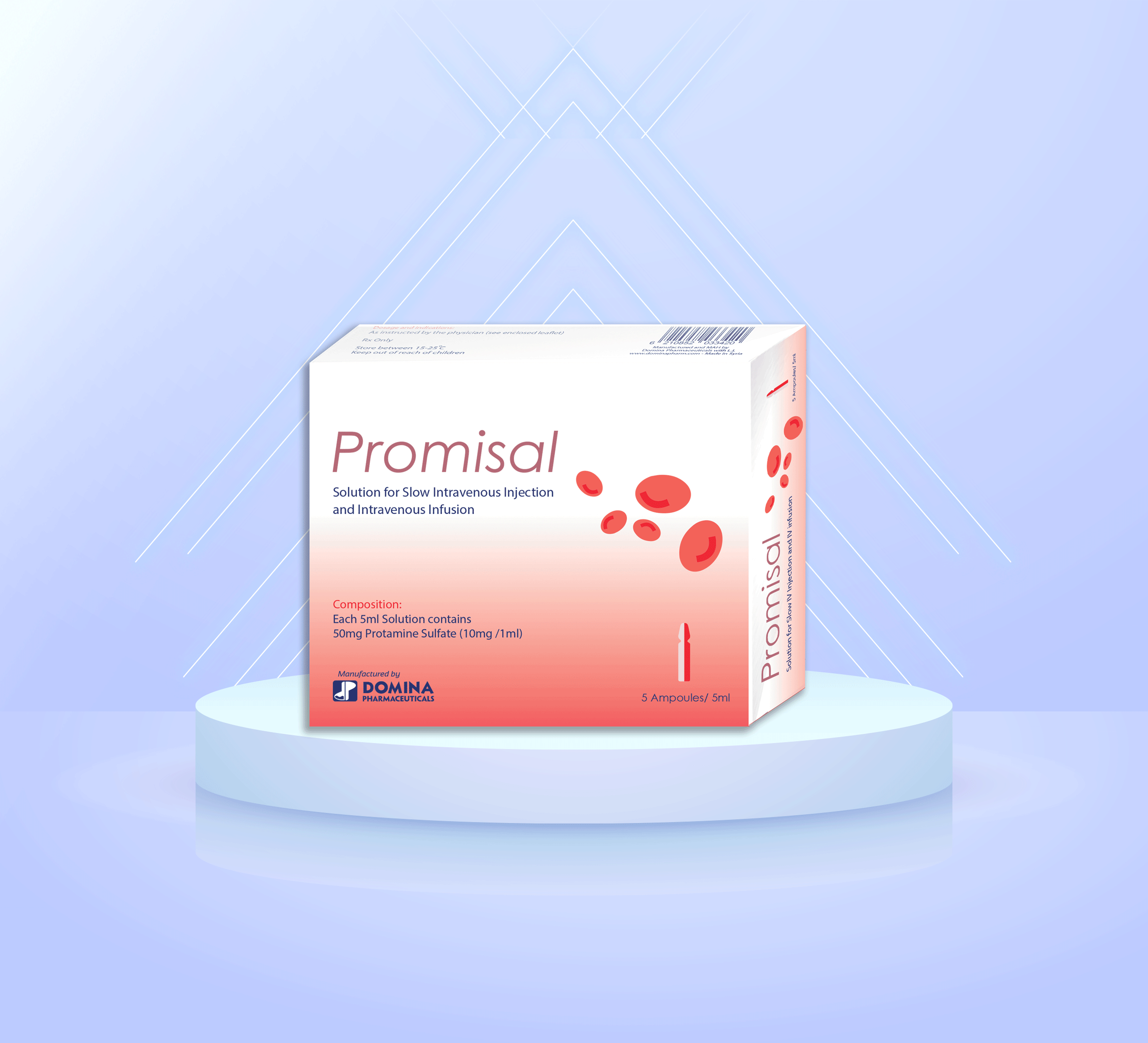
Composition:
Each ampoule 5ml contains 50mg protamine sulfate (10mg/1ml).
Mechanism of action:
Although protamine is a potent antidote for heparin, its precise mechanism of action is unknown. However, when the strongly basic protamine combines with the strongly acid heparin, a stable salt is formed lacking in anticoagulant activity. 1mg of protamine sulfate neutralises between 80 and 120 units of heparin. However, methods of standardisation and the use of heparin from different sources (mucosal, lung) may produce different responses to protamine.
Pharmacokinetic properties:
The onset of action of protamine occurs within five minutes following intravenous administration. The fate of the protamine heparin complex is unknown, but it may be partially degraded, thus freeing heparin.
Indications:
Protamine sulfate is used to counteract the anticoagulant effect of heparin: before surgery; after renal dialysis; after open-heart surgery; if excessive bleeding occurs and when an overdose has inadvertently been given.
Contraindications:
None known.
Posology and method of administration:
Adults and elderly:
Promisal should be administered by slow intravenous injection over a period of about 10 minutes. No more than 50mg of protamine sulfate should be given in any one dose.
The dose is dependent on the amount and type of heparin to be neutralised, its route of administration and the time elapsed since it was last given, since heparin is continuously being excreted.
Ideally, the dose required to neutralise the action of heparin should be guided by blood coagulation studies or calculated from a protamine neutralisation test.
In gross excess, protamine itself acts as an anticoagulant.
Neutralisation of unfractionated (UF) heparins:
1mg of protamine sulfate will usually neutralise at least 100 international units of mucous heparin or 80 units of lung heparin. The dose of protamine sulfate should be reduced if more than 15 minutes have elapsed since intravenous injection.
For example, if 30-60 minutes have elapsed since heparin was injected intravenously, 0.5-0.75mg protamine sulfate per 100 units of mucous heparin is recommended. If two hours or more have elapsed, 0.25-0.375mg per 100 units of mucous heparin should be administered.
If the patient is receiving an intravenous infusion of heparin, the infusion should be stopped and 25-50mg of protamine sulfate given by slow intravenous injection.
If heparin was administered subcutaneously, 1mg protamine sulfate should be given per 100 units of mucous heparin - 25-50mg by slow intravenous injection and the balance by intravenous infusion over 8-16 hours.
In the reversal of UF heparin following cardiopulmonary bypass, either a standard dose of protamine may be given, as above, or the dose may be titrated according to the activated clotting time.
Patients should be carefully monitored using either the activated partial thromboplastin time or the activated clotting time, carried out 5-15 minutes after protamine sulfate administration. Further doses may be needed because protamine is cleared from the blood more rapidly than heparin.
Neutralisation of low molecular weight (LMW) heparins:
A dose of 1mg per 100 units is usually recommended.
The anti-Xa activity of LMW heparins may not be completely reversible with protamine sulfate and may persist for up to 24 hours after administration.
The longer half-life of LMW heparins (approximately twice that of UF heparin) should also be borne in mind when estimating the dose of protamine sulfate required in relation to the time which has elapsed since the last heparin dose.
Theoretically, the dose of protamine sulfate should be halved when one half-life has elapsed since the last LMW heparin dose. Intermittent injections or continuous infusion of protamine sulfate have been recommended for the neutralisation of LMW heparin following subcutaneous administration, as there may be continuing absorption from the subcutaneous depot.
Patients should be carefully monitored. Further doses may be needed because protamine is cleared from the blood more rapidly than heparin, especially low molecular weight heparin.
Children:
Safety and efficacy in children have not been established. Not recommended.
Special warnings and precautions for use:
- Too rapid administration of protamine sulfate may cause severe hypotension and anaphylactoid reactions. Facilities for resuscitation and treatment of shock should be available.
- Protamine sulfate is not suitable for reversing the effects of oral anticoagulants.
- Caution should be observed when administering protamine sulfate to patients who may be at increased risk of allergic reaction to protamine. These patients include those who have previously undergone procedures such as coronary angioplasty or cardio-pulmonary by-pass which may include use of protamine, diabetics who have been treated with protamine insulin, patients allergic to fish and men who have had a vasectomy or are infertile and may have antibodies to protamine.
- Patients undergoing prolonged procedures involving repeated doses of protamine should be subject to careful monitoring of clotting parameters. A rebound bleeding effect may occur up to 18 hours post operatively which responds to further doses of protamine.
Undesirable effects:
Blood and lymphatic system disorders: anticoagulant effect (when used at doses in excess of that required to neutralise the anticoagulant effect of heparin).
Immune system disorders: Hypersensitivity reactions, including angioedema anaphylactoid reactions and fatal anaphylaxis, have been reported.
Cardiac disorders: bradycardia.
Vascular disorders: sudden fall in blood pressure, pulmonary and systemic hypertension, transitory flushing and a feeling of warmth, severe, acute pulmonary vasoconstriction with cardiovascular collapse.
Respiratory, thoracic and mediastinal disorders: Dyspnoea. There have been rare instances of noncardiogenic pulmonary oedema with prolonged hypotension, with significant morbidity and mortality.
Gastrointestinal disorders: nausea and vomiting.
Musculoskeletal and connective tissue disorders: back pain.
General disorders and administration site conditions: lassitude.
Pregnancy and lactation:
As with most drugs, to be used only if clearly indicated in pregnancy and with caution during lactation.
Overdose:
Symptoms: Protamine has weak anticoagulating properties and if given in the absence of heparin, or at doses in excess of those required to neutralize the anticoagulant effect of heparin, exerts its own anticoagulant effect.
Hypotension, bradycardia, dyspnoea nausea, vomiting, lassitude, transitory flushing and/ or a sensation of warmth may also occur.
Treatment: Includes monitoring of coagulation tests, respiratory ventilation and symptomatic treatment. If bleeding is a problem, fresh frozen plasma or fresh whole blood should be given.