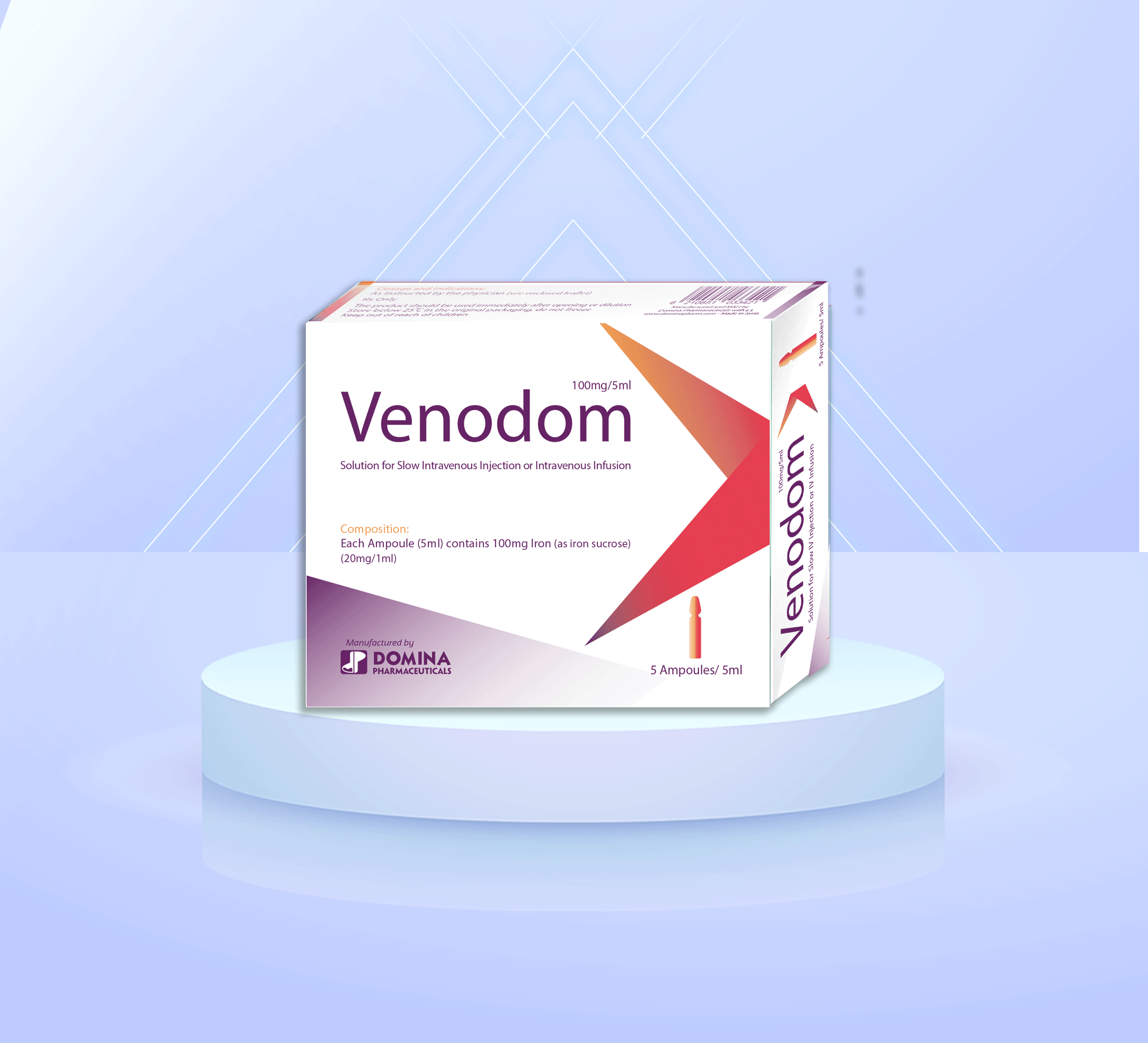
Composition:
Each 5ml solution contains 100mg Iron as Iron sucrose (20mg/ml).
Mechanism of action
Iron sucrose is composed of a polynuclear iron (III)-hydroxide core surrounded by a large number of non-covalently bound sucrose molecules. The complex has a weight average molecular weight (Mw) of approximately 43 kDa. The polynuclear iron core has a structure similar to that of the core of the physiological iron storage protein ferritin. The complex is designed to provide, in a controlled manner, utilisable iron for the iron transport and storage proteins in the body (i.e., transferrin and ferritin, respectively).
Following intravenous administration, the polynuclear iron core from the complex is taken up predominantly by the reticuloendothelial system in the liver, spleen, and bone marrow. In a second step, the iron is used for the synthesis of Hb, myoglobin and other iron-containing enzymes, or stored primarily in the liver in the form of ferritin.
Pharmacokinetic properties:
Biotransformation: Upon injection, sucrose largely dissociates and the polynuclear iron core is mainly taken up by the reticuloendothelial system of the liver, spleen, and bone marrow. At 4 weeks after administration, red cell iron utilization ranged from 59 to 97%.
Elimination: The iron sucrose complex has a weight average molecular weight (Mw) of approximately 43 kDa, which is sufficiently large to prevent renal elimination. Renal elimination of iron, occurring in the first 4 hours after injection of a Venodom dose of 100 mg iron, corresponded to less than 5% of the dose. After 24 hours, the total serum iron concentration was reduced to the pre-dose level. Renal elimination of sucrose was about 75% of the administered dose.
Indications:
Venodom is indicated for the treatment of iron deficiency in the following indications:
• Where there is a clinical need for a rapid iron supply.
• In patients who cannot tolerate oral iron therapy or who are non-compliant.
• In active inflammatory bowel disease where oral iron preparations are ineffective.
• In chronic kidney disease when oral iron preparations are less effective.
The diagnosis of iron deficiency must be based on appropriate laboratory tests (e.g. Hb haemoglobin, serum ferritin, TSAT transferrin saturation, serum iron, etc.).
Contraindications
The use of Venodom is contraindicated in the following conditions:
- Hypersensitivity to the active substance, to Venodom or any of its excipients.
- Known serious hypersensitivity to other parenteral iron products.
- Anaemia not caused by iron deficiency.
- Evidence of iron overload or hereditary disturbances in utilisation of iron.
Posology and method of administration
Monitor carefully patients for signs and symptoms of hypersensitivity reactions during and following each administration of Venodom.
Venodom should only be administered when staff trained to evaluate and manage anaphylactic reactions is immediately available, in an environment where full resuscitation facilities can be assured. The patient should be observed for adverse effects for at least 30 minutes following each Venodom administration.
Posology
The cumulative dose of Venodom must be calculated for each patient individually and must not be exceeded.
Calculation of dosage
The total cumulative dose of Venodom, equivalent to the total iron deficit (mg), is determined by the haemoglobin level (Hb) and body weight (BW). The dose of Venodom must be individually calculated for each patient according to the total iron deficit calculated with the following Ganzoni formula, for example:
Total iron deficit [mg] = BW [kg] x (target Hb - actual Hb) [g/dL] x 2.4* + storage iron [mg]
- Below 35 kg BW: Target Hb = 13 g/dL and storage iron = 15 mg/kg BW
- 35 kg BW and above: Target Hb = 15 g/dL and storage iron = 500 mg
* Factor 2.4 = 0.0034 (iron content of Hb = 0.34%) x 0.07 (blood volume = 7% of BW) x 1000 (conversion of [g] to [mg]) x 10
|
BW |
Total amount of Venodom (20mg iron per mL) to be administered |
|||
|
Hb 6.0g/dL |
Hb 7.5g/dL |
Hb 9.0g/dL |
Hb 10.5g/dL |
|
|
30 kg |
47.5 ml |
42.5 ml |
37.5 ml |
32.5 ml |
|
35 kg |
62.5 ml |
57.5 ml |
50 ml |
45 ml |
|
40 kg |
67.5 ml |
60 ml |
55 ml |
47.5 ml |
|
45 kg |
75 ml |
65 ml |
57.5 ml |
50 ml |
|
50 kg |
80 ml |
70 ml |
60 ml |
52.5 ml |
|
55 kg |
85 ml |
75 ml |
65 ml |
55 ml |
|
60kg |
90mL |
80mL |
67.5mL |
57.5mL |
|
65 kg |
95 ml |
82.5 ml |
72.5 ml |
60 ml |
|
70kg |
100mL |
87.5mL |
75mL |
62.5mL |
|
75 kg |
105 ml |
92.5 ml |
80 ml |
65 ml |
|
80kg |
112.5mL |
97.5mL |
82.5mL |
67.5mL |
|
85 kg |
117.5 ml |
102.5 ml |
85 ml |
70 ml |
|
90 kg |
122.5 ml |
107.5 ml |
90 ml |
72.5 ml |
If the total necessary dose exceeds the maximum allowed single dose, then the administration must be divided.
Adults
5 - 10 mL of Venodom (100 - 200 mg iron) 1 to 3 times a week.
Paediatric population
The use of Venodom has not been adequately studied in children and, therefore, Venodom is not recommended for use in children.
Method of administration
Venodom must only be administered by the intravenous route. This may be by a slow intravenous injection, by an intravenous drip infusion or directly into the venous line of the dialysis machine.
Intravenous drip infusion: Venodom must only be diluted in sterile 0.9% m/V sodium chloride (NaCl) solution. Dilution must take place immediately prior to infusion and the solution should be administered as follows:
|
Venodom dose (mg of iron) |
Venodom dose (mL of Venodom) |
Maximum dilution volume of sterile 0.9% m/V NaCl solution |
Minimum Infusion Time |
|
50mg |
2.5mL |
50mL |
8 minutes |
|
100mg |
5mL |
100mL |
15 minutes |
|
200mg |
10mL |
200mL |
30 minutes |
For stability reasons, dilutions to lower Venodom concentrations are not permissible.
Intravenous injection: Venodom may be administered by slow intravenous injection at a rate of 1 mL undiluted solution per minute and not exceeding 10 mL Venodom (200 mg iron) per injection.
Injection into venous line of dialysis machine :Venodom may be administered during a haemodialysis session directly into the venous line of the dialysis machine under the same conditions as for intravenous injection.
Special warnings and precautions for use
- Parenterally administered iron preparations can cause hypersensitivity reactions including serious and potentially fatal anaphylactic/anaphylactoid reactions.
- Hypersensitivity reactions have also been reported after previously uneventful doses of parenteral iron complexes including iron sucrose. There have been reports of hypersensitivity reactions which progressed to Kounis syndrome (acute allergic coronary arteriospasm that can result in myocardial infarction).
- For known serious hypersensitivity to other parenteral iron products.
- The risk of hypersensitivity reactions is enhanced for patients with known allergies including drug allergies, including patients with a history of severe asthma, eczema or other atopic allergy.
- There is also an increased risk of hypersensitivity reactions to parenteral iron complexes in patients with immune or inflammatory conditions (e.g. systemic lupus erythematosus, rheumatoid arthritis).
- Venodom should only be administered when staff trained to evaluate and manage anaphylactic reactions is immediately available, in an environment where full resuscitation facilities can be assured. Each patient should be observed for adverse effects for at least 30 minutes following each Venodom injection. If hypersensitivity reactions or signs of intolerance occur during administration, the treatment must be stopped immediately. Facilities for cardio respiratory resuscitation and equipment for handling acute anaphylactic/anaphylactoid reactions should be available, including an injectable 1:1000 adrenaline solution.
- Additional treatment with antihistamines and/or corticosteroids should be given as appropriate.
- In patients with liver dysfunction, parenteral iron should only be administered after careful risk/benefit assessment. Parenteral iron administration should be avoided in patients with hepatic dysfunction where iron overload is a precipitating factor, in particular Porphyria Cutanea Tarda (PCT). Careful monitoring of iron status is recommended to avoid iron overload.
- Parenteral iron should be used with caution in the case of acute or chronic infection. It is recommended that the administration of Venodom is stopped in patients with bacteraemia. In patients with chronic infection, a risk/benefit evaluation should be performed.
- Paravenous leakage must be avoided because leakage of Venodom at the injection site can lead to pain, inflammation and brown discoloration of the skin.
- Venodom must not be mixed with other medicinal products except sterile 0.9% sodium chloride solution for dilution. The diluted solution must appear as brown and clear.
- Each ampoule of Venodom is intended for single use only.
Undesirable effects
The most commonly reported adverse drug reaction in clinical trials was dysgeusia, which occurred with a rate of 4.5 events per 100 subjects.
The most important serious adverse drug reactions associated are hypersensitivity reactions, which occurred with a rate of 0.25 events per 100 subjects in clinical trials.
Anaphylactoid/anaphylactic reactions were reported (estimated as rare).
|
System Organ Class |
Common (≥ 1/100,<1/10) |
Uncommon (≥1/1,000, <1/100) |
Rare (≥ 1/10,000,<1/1,000) |
Frequency not known) |
|
Immune system disorders |
|
Hypersensitivity |
|
Anaphylactoid/anaphylactic |
|
Nervous system disorders |
Dysgeusia |
Headache, dizziness, |
Syncope, |
Depressed level ofconsciousness, confusionalstate, |
|
Cardiac disorders |
|
|
Palpitations |
Bradycardia, tachycardia, |
|
Vascular disorders |
Hypotension, hypertension |
Flushing, phlebitis |
|
Circulatory collapse, |
|
Respiratory, thoracic and |
|
Dyspnoea |
|
Bronchospasm |
|
Renal and urinary |
|
|
Chromaturia |
|
|
Gastrointestinal Disorders |
Nausea |
Vomiting, abdominalpain, |
|
|
|
Skin and subcutaneous |
|
Pruritus, rash |
|
Urticaria, erythema |
|
Musculoskeletal and |
|
Muscle spasm, myalgia, arthralgia, |
|
|
|
General disorders and |
Injection/ |
Chills, asthenia, fatigue, |
Chest pain, |
Cold sweat, malaise, pallor, |
|
Investigations |
|
Alanine |
Blood lactate |
|
Interaction with other medicinal products and other forms of interaction
As with all parenteral iron preparations, Venodom should not be administered concomitantly with oral iron preparations since the absorption of oral iron is reduced.
Therefore, oral iron therapy should be started at least 5 days after the last injection of Venodom.
Incompatibilities
There is the potential for precipitation and/or interaction if mixed with other solutions or medicinal products. The compatibility with containers other than glass, polyethylene and PVC is not known.
Pregnancy and lactation
The use of Venodom in pregnant women in the second and third trimester showed no safety concerns for the mother or newborn.
A careful risk/benefit evaluation is required before use during pregnancy and Venodom should not be used during pregnancy unless clearly necessary.
Iron deficiency anaemia occurring in the first trimester of pregnancy can in many cases be treated with oral iron. Treatment with Venodom should be confined to second and third trimester if the benefit is judged to outweigh the potential risk for both the mother and the foetus.
Foetal bradycardia may occur following administration of parenteral irons. It is usually transient and a consequence of a hypersensitivity reaction in the mother.
The unborn baby should be carefully monitored during intravenous administration of parenteral irons to pregnant women.
Preclinical data do not indicate direct or indirect harmful effects to the nursing child. Non metabolised iron sucrose is unlikely to pass into the mother's milk.
Effects on ability to drive and use machines
In the case of symptoms of dizziness, confusion or light headedness following the administration of Iron sucrose, patients should not drive or use machinery until the
symptoms have ceased.
Overdose
Overdose can cause iron overload which may manifest itself as haemosiderosis. Overdose should be treated, as deemed necessary by the treating physician, with an iron chelating agent or according to standard medical practice.
Shelf life:
Shelf life of the product as packaged for sale: 3 years.
Shelf life after first opening of the container: From a microbiological point of view, the product should be used immediately.
Shelf life after dilution with sterile 0.9% m/V sodium chloride (NaCl) solution: From a microbiological point of view, the product should be used immediately after dilution with sterile 0.9% m/V sodium chloride solution.